Quick answer
Do not pour fat, oil or grease, coffee grounds, rice, pasta, flour or food scraps down the sink, and never flush wet wipes. Fat cools and hardens in pipes, then binds with wipes and food to form fatbergs. Let cooking fat cool, scrape it into a sealed container and put it in the general waste bin.
Key takeaways
- Fat, oil and grease (FOG) hardens as it cools, even if it goes down hot.
- Coffee grounds, rice and pasta clump or swell and catch fat in the pipe.
- Fatbergs form when FOG binds with wet wipes and food waste in sewers.
- Cool, scrape and bin cooking fat; wipe pans with kitchen paper before washing.
- Commercial kitchens need a properly sized, regularly emptied grease trap.
What should you never pour down the kitchen sink?
You should never pour fat, oil or grease down the kitchen sink, and you should keep food waste, coffee grounds and wet wipes out of it too. These are the main causes of blocked kitchen sinks at home and of the much larger fatbergs that form in the sewers.
- Fat, oil and grease (FOG): cooking oil, dripping, bacon fat, butter, gravy, salad dressings, and the fatty water from roasting tins.
- Coffee grounds: they do not dissolve and settle into a dense sludge in the trap and pipe.
- Rice, pasta and bread: starchy foods keep absorbing water and swell, forming a sticky paste.
- Flour and batter: mixed with water, they turn into something close to glue.
- Eggshells and food scraps: small hard pieces collect at bends and catch everything else.
- Wet wipes, kitchen roll and cotton pads: they do not break down like toilet paper and act as a net for fat.
- Paint, solvents and medicines: these harm the water environment and should go to a proper disposal point.
What is a fatberg?
A fatberg is a hard, solid mass of congealed fat, oil and grease bound together with wet wipes and other waste that should not be in the sewer. It builds up over time, sticking to the pipe walls and narrowing the space for wastewater until the sewer blocks.
The best-known example is the Whitechapel fatberg found in 2017. It weighed about 130 tonnes and stretched roughly 250 metres through a Victorian sewer in east London. Clearing it took weeks of work by sewer teams.
London’s main sewers date back to Joseph Bazalgette’s network, built after the “Great Stink” of 1858. They were never designed to cope with modern quantities of wipes and cooking fat, which is why fatbergs are a recurring problem.
Why does fat block drains if it goes down hot?
Fat blocks drains because it cools and hardens as soon as it leaves the warm sink and reaches colder pipes. Pouring it down with hot water, or following it with washing-up liquid, only moves the problem a little further down the pipe before it sets.
Over weeks and months, thin layers of fat coat the inside of the waste pipe. Food particles and coffee grounds stick to that coating, the pipe narrows, and water starts to drain slowly. Eventually it stops altogether, usually at a bend or where the kitchen waste joins the main drain.
How should you dispose of cooking fat and oil?
The safest way to dispose of cooking fat is to let it cool, scrape or pour it into a sealable container, and put it in your general waste bin. Small amounts can be soaked up with kitchen paper and binned.
- Let fat and oil cool in the pan so it is safe to handle.
- Pour or scrape it into an old jar, tub or carton with a lid.
- Wipe greasy pans, plates and roasting tins with kitchen paper before washing them.
- Put the sealed container and used paper in the general waste bin.
- For large amounts of used cooking oil, check with your local council, as many household recycling centres accept it.
Food scraps should go in the bin or, if your council collects it, the food waste caddy. A simple sink strainer catches rice, peelings and coffee grounds before they reach the pipe.
How can you tell your kitchen sink is getting blocked?
The early signs of a blocked kitchen sink are slow draining, gurgling noises and a bad smell from the plughole. Acting at this stage is far easier than waiting until the sink fills with standing water.
- Water takes longer than usual to drain away.
- The plughole gurgles or bubbles after the sink empties.
- There is a stale or rotten smell, even after cleaning.
- The outside gully that the kitchen pipe drains into is full of grease or overflowing.
- The dishwasher or washing machine leaves water standing in the sink.
How do you clear a sink blocked with grease?
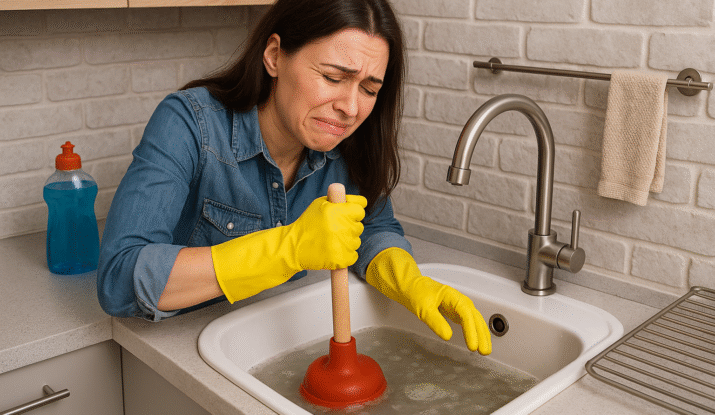
A sink blocked with grease can often be cleared with a sink plunger, or by removing and cleaning the trap under the sink. Wear rubber gloves and put a bowl underneath before you start.
- Plunge: block the overflow with a damp cloth, add a few centimetres of water and plunge firmly to shift the blockage.
- Clean the trap: unscrew the U-bend or bottle trap, empty it into a bucket, clean out the grease and refit it hand-tight.
- Use hot, not boiling, water: hot water with washing-up liquid can help loosen a light coating, but it will not clear a solid build-up and boiling water can damage plastic pipe joints.
Be careful with chemical drain cleaners. Never mix different products, never mix them with bleach, and do not plunge after using one, as caustic water can splash. If the blockage is beyond the trap, it usually needs a drain engineer. Our blocked sink page explains how we clear them.
What do commercial kitchens need to do about grease?
Commercial kitchens need to stop fat, oil and grease getting into the drains, which in practice means a properly sized grease trap or grease separator, regular emptying and good kitchen habits. Restaurants, takeaways, cafés and pubs produce far more FOG than a household, and a single blocked drain can force a kitchen to close.
Under the Water Industry Act 1991 it is an offence to put anything into a public sewer that is likely to interfere with the free flow of its contents, and Thames Water can take action where a business is found to be causing blockages.
Good practice for food businesses includes:
- Fitting a grease trap or separator suited to the size of the kitchen, and keeping it maintained.
- Emptying and cleaning grease traps on a regular schedule, not only when there is a problem.
- Scraping plates and pans into the food waste bin before washing up.
- Using sink strainers on every sink and keeping waste cooking oil for collection by a licensed waste carrier.
- Training staff, including new and temporary staff, on what must not go down the drain.
- Booking routine drain jetting so grease build-up is removed before it causes a blockage.
We work with restaurants and takeaways on busy high streets across London, including in Hackney, Westminster and Camden. High-pressure water jetting clears hardened grease from the pipe walls, and our sewer cleaning and drain jetting service can be booked as regular maintenance.
Need help with a greasy or blocked drain?
If your sink or kitchen drain is slow, smelly or fully blocked, Pipe & Drain Cleaners can help any time. Call 0800 470 0946 24/7, or book a time slot online. Our engineers give a fixed quote before starting work.
Frequently asked questions
Is it OK to pour cooking oil down the sink with hot water?
No. Hot water only keeps oil liquid for a short distance. Once it reaches cooler pipes or the sewer it sets, coating the pipe and trapping food and wipes. Let oil cool, pour it into a sealed container and put it in the general bin, or take large amounts to a council recycling centre that accepts it.
Can coffee grounds go down the sink?
Coffee grounds should not go down the sink. They do not dissolve, and they settle into a dense layer in the trap and pipe that clumps together with grease. Put them in the bin, your food waste caddy if your council collects food waste, or a garden compost heap.
Does washing-up liquid break down grease in drains?
Washing-up liquid helps lift grease off plates, but it does not stop fat setting once it is in the pipe. The fat and detergent mix travels a little further, cools and hardens again. It is much better to wipe greasy pans with kitchen paper first and bin the fat.
Are biological or enzyme drain treatments worth using?
Enzyme or bacterial drain treatments can help keep pipes cleaner when used regularly as directed, especially in kitchens. They are not a fix for a blocked sink and will not remove a hardened grease build-up. A blockage that is already there usually needs plunging, trap cleaning or professional drain jetting.
Who is responsible for a fatberg in the sewer?
Fatbergs in public sewers are dealt with by the sewerage company, which in London is Thames Water. A blockage in the drain that serves only your property, within your boundary, is generally your responsibility. If fat from a business is found to be causing blockages, the water company can take action against that business.
Need a drain engineer in London?
Call free on 0800 470 0946 any time, or pick a time that suits you online.
Comments (2)
How Much Does Drain Unblocking Cost in London?
[…] cleared safely yourself; our guide blocked drain: what to do right now covers the safe steps, and what not to pour down the sink explains how to stop it […]
Blocked Sink? How to Unblock It Safely, Step by Step
[…] How Much Does Drain Unblocking Cost in London? on What Not to Pour Down the Sink: Fatbergs and Blocked Sinks […]