Engineers available 24/7 across London
Drain Jetting & Sewer Cleaning in London
High-pressure water jetting that scours grease, scale, silt and roots from London drains and private sewers, day or night.
Call free, any time0800 470 0946
- 24/7 across all London boroughs
- No call-out fee
- Fixed quote before work starts
- Domestic and commercial customers
Speak to an engineer now
Freephone · answered 24 hours a day
- No call-out fee
- Fixed quote before work starts
- Trained, insured engineers
- All 32 boroughs + the City
Quick answer
Drain jetting is the cleaning of drains and sewers with high-pressure water fired through a flexible hose and nozzle, which scours away grease, scale, silt and roots. Pipe & Drain Cleaners jets drains across all of London 24/7, with a fixed quote before work starts and no call-out fee. Call 0800 470 0946 or book online.
Drain jetting in London is the fastest way to restore a drain or private sewer to full flow: a jet of high-pressure water cuts through grease, sludge, scale and root growth and flushes it all away, rather than just punching a hole through the blockage. Pipe & Drain Cleaners provides high-pressure water jetting and sewer cleaning 24 hours a day, 7 days a week, across every London borough, from Victorian terraces in Islington and Lambeth to restaurants in Westminster and blocks of flats in Croydon.
Jetting is the right choice when a drain keeps blocking, runs slowly along its whole length, smells, or has been lined with fat or scale over the years. It is also the standard way to clean a drain thoroughly before a CCTV drain survey, so the camera can see the pipe walls clearly.
With 12+ years’ experience and 20+ vans across London, our fully trained, insured engineers jet drains for homeowners, landlords, letting agents, restaurants, offices and shops. You get a fixed quote before any work starts, with no hidden charges.
How do I know if my drain needs jetting?
The same drain keeps blocking
If a drain has been rodded clear but blocks again within weeks, something is coating or narrowing the pipe. Jetting cleans the full bore of the pipe instead of just clearing a path.
Water drains slowly from several fittings
When sinks, showers and toilets all drain sluggishly, the shared underground drain is usually narrowed by grease, silt or scale rather than fully blocked.
Gurgling and bad smells
Gurgling plugholes and a stale or sewage smell around gullies often point to sludge and grease sitting in the drain and breaking down.
An inspection chamber that fills up
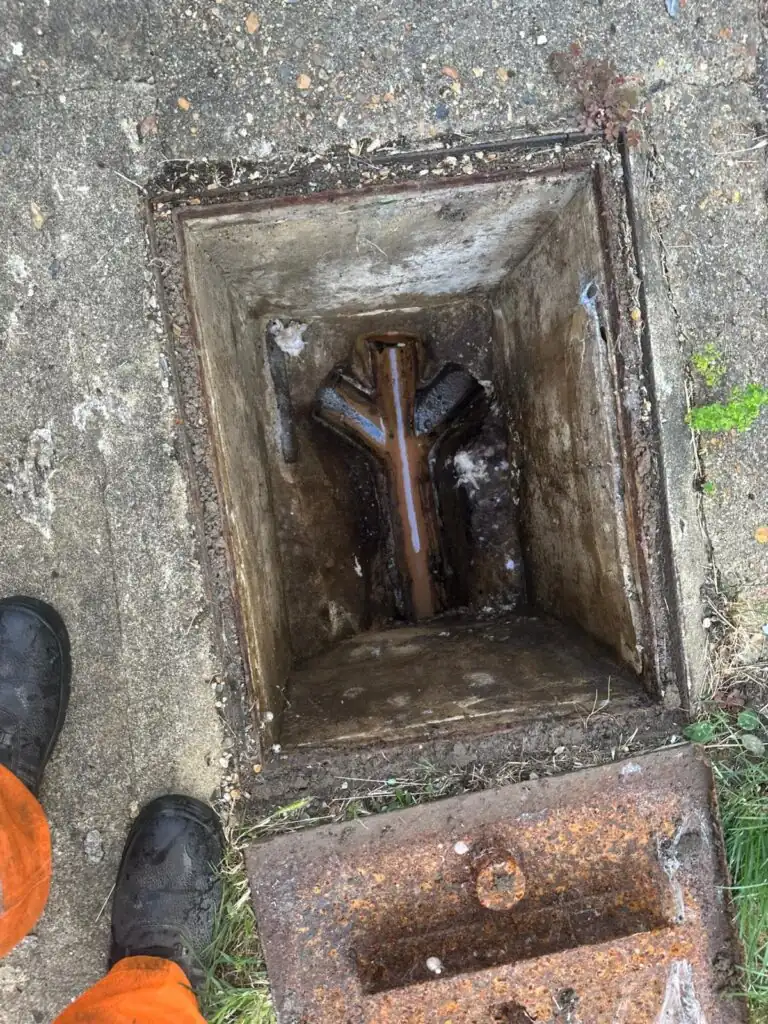
If water sits high in the inspection chamber (manhole) after use, the pipe leaving it is restricted. Look from above only, never climb in.
Grease or debris at outside gullies
A grey, greasy crust around a kitchen gully is a sign that fat is setting further down the drain, a classic early fatberg in the making.
What builds up inside London drains and sewers?
Fat, oil and grease (FOG)
Cooking fat poured down sinks cools and hardens on pipe walls, trapping food scraps and wipes. In London’s sewers this is how fatbergs form, like the 130-tonne Whitechapel fatberg found in 2017.
Wet wipes and sanitary items
Wipes, even those labelled “flushable”, don’t break down like toilet paper. They snag on rough joints and bind with grease into stubborn masses.
Hard water scale
London’s water is hard, and limescale, along with mineral deposits and hardened sludge, can slowly narrow pipes. Descaling with jetting removes this crust and restores the pipe’s full bore.
Tree roots
London plane trees and garden trees send fine roots into cracked or loose joints in old clay drains looking for moisture. Roots grow into dense mats that catch everything passing through.
Silt, sand and building debris
Silt washes in through yard gullies, and building work can leave sand, mortar and rubble in drains. Over time this settles in the bottom of the pipe and reduces its capacity.
Ageing Victorian pipework
Rough, shifted joints in old clay and pitch-fibre pipes catch debris far more easily than smooth modern plastic pipe.
Need it sorted today?
Call free on 0800 470 0946 any time, or pick a time that suits you online.
How drain jetting works: step by step
- 1. Book or call
Call us any time for urgent jobs, or choose a day and a 3-hour window online for planned work.
- 2. Find access and assess
The engineer locates the inspection chambers, rodding eyes or gullies, checks which way the drain runs and identifies where the problem sits.
- 3. Fixed quote
You get a clear, fixed quote before any work starts, with no call-out fee. If a camera inspection is needed to understand the problem, we explain that first.
- 4. Jetting the drain
A flexible jetting hose with a specialist nozzle is fed into the pipe. Rear-facing jets drive the hose forward while scouring the pipe walls, and the loosened debris is flushed downstream as the hose is drawn back.
- 5. Test the flow
We run water through the system and watch the inspection chambers to confirm the drain is flowing freely along its length.
- 6. Advice or survey if needed
If the drain looks damaged, keeps blocking or has root ingress, we can recommend a CCTV drain survey so you can see exactly what is happening inside the pipe.
What equipment do we use to clean drains and sewers?
High-pressure water jetting
Our main tool for sewer cleaning. Water at high pressure is delivered through a reinforced hose and nozzle that travels inside the pipe, scouring grease, scale and silt from the walls and flushing it away. It cleans the whole circumference of the pipe, not just the centre.
Jetting nozzles for different jobs
Different nozzles do different work: penetrating nozzles open up solid blockages, while scouring and cutting heads are used for drain descaling, heavy grease and fine root growth. The engineer chooses the head and pressure to suit the pipe material and condition.
Mechanical drain rodding
Rods are used to break through dense, compacted blockages or where jetting access is limited. Rodding and jetting are often combined: rods to open the drain, the jetter to clean it.
CCTV drain cameras
A camera survey shows what causes a recurring problem and spots cracks, displaced joints or collapses that jetting alone won’t fix.
Can I jet or clean a drain myself?
You can keep drains healthy with simple habits, but jetting an underground drain or sewer is a job for trained engineers with the right equipment.
Safe to try
- Scrape cooled fat, oil and grease into the bin, never down the sink
- Use sink strainers and plughole hair catchers
- Only flush pee, poo and toilet paper
- Keep outside gullies clear of leaves, silt and food waste
- Lift an inspection chamber cover with gloves to see if it is full, without climbing in
Avoid
- Don’t push a domestic pressure washer into a drain: it can pack debris tighter and spray contaminated water back at you
- Don’t pour boiling water or neat bleach down to shift grease; it moves the fat further down where it sets again
- Never mix chemical drain cleaners
- Never enter a manhole, inspection chamber or sewer, as they can contain harmful gases
- Don’t ignore a drain that keeps blocking; repeated blockages usually mean build-up or damage inside the pipe
Call a professional straight away if
- Sewage is backing up into a toilet, shower or basement
- An inspection chamber or outside gully is overflowing
- Several fittings are slow or the same drain blocks again and again
- A restaurant or kitchen drain is backing up with grease
- A survey has found roots, heavy scale or silt in the drain
Is the sewer private or Thames Water's responsibility?
It depends on where the pipe runs and who it serves. Thames Water is the sewerage company for all of Greater London and is responsible for public sewers. Since 1 October 2011, shared private sewers and lateral drains (the sections outside your property boundary, or shared with neighbours) transferred to water companies, so in London most of those are now Thames Water’s.
As a general rule:
- Your responsibility: the drain that serves only your property and sits within your boundary, including the pipes from your sinks, toilets and gullies to your inspection chamber.
- Usually Thames Water’s: shared sewers serving more than one property, and lateral drains beyond your boundary.
- Rented homes: landlords are usually responsible for the drains, while tenants may be liable for blockages they cause, such as wipes or fat. Check the tenancy agreement.
Private sewer cleaning still matters. In blocks of flats, converted houses and commercial premises, long runs of private pipework inside the boundary are often the freeholder’s or managing agent’s to maintain. Our engineers can jet these drains and, where useful, use a camera to show where a blockage sits, so you know whether it is yours to fix. Our guide on who is responsible for a blocked drain in London explains this in more detail.
How does high-pressure water jetting remove grease, scale and roots?
High pressure water jetting works by combining force and flow: the water both cuts into deposits and carries them away. The nozzle on the end of the hose has jets facing backwards that pull the hose along the pipe and blast the walls as it goes, plus forward jets that break into the blockage ahead.
- Grease and fatberg removal: hardened FOG is broken up and flushed down the line.
- Drain descaling: scale and hardened sludge are scoured off with suitable nozzles, restoring the pipe’s original diameter so it flows properly again.
- Root removal: fine roots growing through joints can be cut back with a cutting head. Because roots enter through cracks, they often return, so a CCTV survey helps decide whether a repair is needed. Read more in our guide to tree roots in drains.
- Silt and debris: settled silt and building waste are washed downstream and out of the private drain.
The engineer adjusts the pressure and nozzle to the pipe. Older clay and pitch-fibre drains, common under London’s Victorian and Edwardian terraces, need more care than modern plastic pipes. If a pipe is badly cracked or collapsed, jetting can’t fix it, and we will tell you so rather than risk making it worse.
Do London's Victorian sewers make drain jetting more important?
Yes, older drains tend to need cleaning more often. London’s main sewer network was built by Joseph Bazalgette after the Great Stink of 1858, and much of the city’s private pipework dates from the same era. Clay and pitch-fibre pipes have more joints, rougher surfaces and more places for grease, roots and silt to catch than modern pipes.
That is why we see recurring build-up in period housing across Hackney, Camden, Southwark and Wandsworth, and in tree-lined streets in Richmond upon Thames and Barnet. A thorough jet clean, followed by a camera inspection where needed, is a practical way to keep these older drains working and to spot damage early.
How much does drain jetting cost in London?
The cost of drain jetting depends on the job, so we give you a fixed quote before any work starts, with no call-out fee and no hidden charges. The main things that affect the price are:
- Access: whether there is an easy inspection chamber or rodding eye, or the drain has to be reached through a gully or fitting.
- Length and size of the run: a short domestic drain takes less time than a long shared run under a block of flats or commercial premises.
- What is in the pipe: light silt clears quickly, while heavy grease, hard scale or root growth may need several passes and different nozzles.
- Whether CCTV is needed: a camera inspection is worthwhile if the problem keeps coming back or the pipe may be damaged.
- Timing: urgent work at night or at weekends versus a planned visit.
Call 0800 470 0946 to describe the problem and get a quote, or book online for a planned visit.
For landlords, agents and businesses
Commercial drain cleaning keeps restaurants, cafés, offices, shops and blocks of flats running without disruption. Commercial kitchens are the biggest source of FOG in London’s sewers, and even with a grease trap in place, fat can build up in the drain beyond it. Regular jetting removes grease before it hardens into a blockage that closes a kitchen during service. For blocks of flats, landlords and letting agents, long shared private drains collect wipes, grease and silt from many households.
Planned drain maintenance means booking jetting at regular intervals rather than waiting for an emergency. Book a slot online or call us for out-of-hours work. We cover commercial premises across London, from the City of London and Westminster to business parks and high streets in every borough.
Frequently asked questions
What is drain jetting?
Drain jetting is the cleaning of a drain or sewer with a jet of high-pressure water delivered through a flexible hose and nozzle that travels inside the pipe. It breaks up blockages and scours grease, scale, silt and roots from the pipe walls, then flushes the debris away. It cleans the whole pipe rather than just clearing a path through the blockage.
Where can I get drain jetting in London?
Pipe & Drain Cleaners provides drain jetting in London across all 32 boroughs and the City of London, 24 hours a day, 7 days a week. Call 0800 470 0946 for urgent jobs or book a 3-hour slot online for planned work. You get a fixed quote before any work starts, with no call-out fee.
Is drain jetting better than rodding?
They do different jobs. Rodding is good for pushing through a solid, compacted blockage, while jetting cleans the full width of the pipe and removes grease, scale and silt that rodding leaves behind. For a drain that keeps blocking, jetting usually gives a longer-lasting result. Engineers often use both: rods to open the drain and the jetter to clean it.
Can high-pressure jetting damage old drains?
Jetting is safe for drains in reasonable condition when the engineer matches the pressure and nozzle to the pipe. Old clay and pitch-fibre drains, common in London, need more care. If a pipe is already cracked, displaced or collapsed, jetting can't repair it, so a CCTV survey is the sensible next step before deciding on further work.
Does jetting remove tree roots from drains?
Jetting with a cutting head can remove fine roots growing through pipe joints and restore flow. However, roots get in through cracks or loose joints, so they often grow back. A CCTV survey shows how much damage there is and whether the drain needs repairing as well as cleaning.
Who is responsible for cleaning a sewer in London?
Thames Water is responsible for public sewers in London, and since October 2011 that includes most shared sewers and lateral drains outside property boundaries. You are generally responsible for the drain that serves only your property within your boundary. In rented homes the landlord is usually responsible, though tenants may pay for blockages they cause.
How often should a restaurant have its drains jetted?
It depends on how much cooking you do, how well grease is managed and how old the pipework is. Busy kitchens often benefit from regular planned jetting rather than waiting for a blockage. The engineer can suggest an interval based on what they find in the pipe.
Can you remove a fatberg from my drain?
Yes, fatberg removal from private drains is a typical jetting job. High-pressure water breaks up hardened fat, wipes and debris and flushes them away, sometimes over several passes. If the fatberg is in a public sewer, it is Thames Water's responsibility. To stop it coming back, keep fat out of the sink and only flush toilet paper.
Do I need a CCTV survey after jetting?
Not always. If jetting clears the drain and it was a one-off build-up, a survey may not be needed. A CCTV survey is worthwhile if the drain keeps blocking, roots are present, the pipe may be damaged or you are buying a property or planning an extension.
Helpful guides
Drain Jetting & Sewer Cleaning in London: every borough
We work across all 32 London boroughs and the City of London, day and night. Choose your area or find your postcode.
- Barking and Dagenham
- Barnet
- Bexley
- Brent
- Bromley
- Camden
- City of London
- Croydon
- Ealing
- Enfield
- Greenwich
- Hackney
- Hammersmith and Fulham
- Haringey
- Harrow
- Havering
- Hillingdon
- Hounslow
- Islington
- Kensington and Chelsea
- Kingston upon Thames
- Lambeth
- Lewisham
- Merton
- Newham
- Redbridge
- Richmond upon Thames
- Southwark
- Sutton
- Tower Hamlets
- Waltham Forest
- Wandsworth
- Westminster
Blocked right now? We're open 24/7
Call free on 0800 470 0946 any time, or pick a time that suits you online.