Quick answer
In London, a homeowner is usually responsible for drains that serve only their property and sit within their boundary. Since 1 October 2011, shared drains and the pipes beyond your boundary are generally Thames Water's responsibility. In rented homes the landlord is usually responsible, though tenants may pay for blockages they cause, such as wipes or fat.
Key takeaways
- You usually own drains that serve only your home and sit inside your boundary.
- Since 1 October 2011, shared drains and lateral drains generally belong to Thames Water.
- Landlords usually handle drain problems in rented homes; check your tenancy agreement.
- Lifting inspection chamber covers (never climbing in) helps show where a blockage is.
- A CCTV drain survey can confirm exactly which pipe is blocked or damaged.
Who is responsible for a blocked drain in London?
It depends on which pipe is blocked. As a general rule, you are responsible for drains that serve only your property and sit within your property boundary, while Thames Water is generally responsible for shared drains and for the pipes that run beyond your boundary to the public sewer.
Thames Water is the sewerage company for the whole of Greater London, so whether you live in Camden, Croydon or Hackney, the same basic rules apply. The tricky part is working out where your pipe ends and the shared or public one begins.
What changed in 2011?
On 1 October 2011, most private sewers and lateral drains in England and Wales transferred to the water companies. Before that date, homeowners could be jointly liable for shared pipes running under their neighbours’ gardens, which often led to disputes and expensive surprises.
After the transfer, two types of pipe generally became the water company’s responsibility:
- Shared private sewers – pipes that carry waste from more than one property, even if they run through your garden.
- Lateral drains – the section of pipe serving your property that sits outside your boundary, for example under the pavement or road, before it joins the public sewer.
In London, that means Thames Water now looks after a large network of pipes that used to be private. What stayed private is the drain that serves only your home and runs within your own land.
What is the boundary rule?
The boundary rule is simple in principle: a pipe that serves only your property is yours up to your property boundary, and beyond that it is generally the water company’s. Once your pipe joins a pipe that also carries a neighbour’s waste, the shared section is generally the water company’s too.
In practice:
- A blocked sink trap, toilet or gully outside your back door is almost always your responsibility.
- A blocked drain running from your house to an inspection chamber in your garden, carrying only your waste, is usually your responsibility.
- A blockage in a pipe shared with next door, or under the pavement, is usually Thames Water’s to deal with.
Who is responsible if the drain is shared with neighbours?
If a drain carries waste from more than one property and connects to the public sewer, it is generally the water company’s responsibility since the 2011 transfer. This is common in London terraces, where several houses often connect into one pipe running along the back gardens before it reaches the street.
Shared drains do not usually make your neighbours liable for your blockage, or you for theirs. However, if one household causes the blockage, for example by pouring fat down the sink, the cause can still matter. Keeping wipes and grease out of the drains protects everyone on the run.
Who is responsible in a rented home or flat?
In a rented home, the landlord is usually responsible for keeping the drains in working order. Tenants are usually responsible for blockages they cause themselves, such as flushing wet wipes, sanitary products or pouring cooking fat down the sink.
Always check your tenancy agreement, as it may set out who arranges and pays for drain work. If you are a tenant, report the problem to your landlord or letting agent in writing as soon as possible. If you live in a leasehold flat, communal drains are often the freeholder’s or management company’s responsibility, so check your lease.
Landlords and letting agents can find more on our blocked drains service page.
How can I tell which pipe is mine?
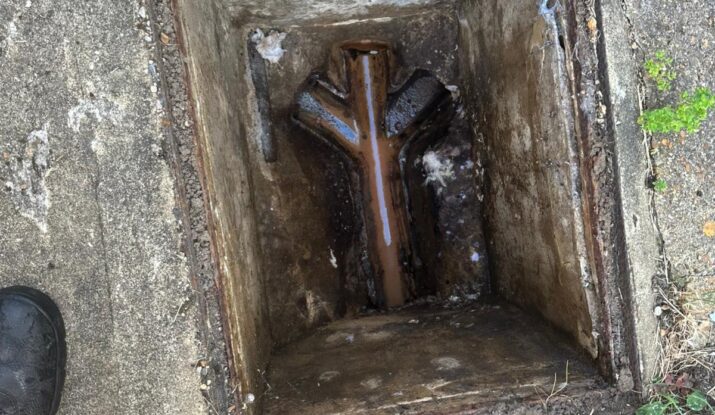
The quickest way is to look at your inspection chambers, the small manhole covers usually found in a garden, side passage or driveway. They give access to the drain and show which direction waste flows.
- Find your covers. Older London houses often have one at the back and sometimes one at the front.
- Put on gloves and lift the cover carefully. Covers can be heavy; lift with your legs and keep fingers clear. Never climb into a chamber.
- Check whether it is full or empty. If the chamber nearest the house is full of water and the next one downstream is empty, the blockage is likely between them.
- Work out who uses that section. If only your house drains into that stretch, it is likely yours. If a neighbour’s pipe joins it, or it runs beyond your boundary, it is likely Thames Water’s.
If you cannot find a cover or the layout is unclear, a CCTV drain survey can trace the route of the pipe and show exactly where the problem is. When you buy a home, your conveyancing drainage search can also show whether the property connects to the public sewer.
What should I do next?
Start by working out whether the blockage is inside your home or in the drain outside.
- Only one sink, bath or toilet is slow: the problem is probably in that fitting or its waste pipe, which is your responsibility (or your landlord’s).
- Several fittings are backing up, or the chamber in your garden is full: the blockage is in the underground drain, and you need to find out which section.
- The blockage looks like it is in a shared or public pipe: contact Thames Water and report it.
- The blockage is in your private drain: arrange for a drainage company to clear it.
If sewage is coming up into your home or garden, avoid contact with it, keep children and pets away and get professional help quickly.
What if Thames Water says the drain is mine?
If there is disagreement about who owns a section of pipe, evidence helps. A CCTV survey records video of the inside of the drain and shows where the blockage or defect sits in relation to your boundary and to any shared connections. You can then share that with Thames Water, your landlord or your neighbour.
Need help with a blocked drain in London?
If the blockage is in your private drain, or you are not sure whose it is, Pipe & Drain Cleaners can help. We work across all 32 London boroughs and the City of London, including Islington and Barnet, and give a fixed quote before any work starts. Call 0800 470 0946 any time, 24/7, or book online for a time slot that suits you.
Frequently asked questions
Is Thames Water responsible for the drain outside my house?
Usually, yes, if the pipe is outside your property boundary or is shared with other properties. Since the 2011 transfer, lateral drains under pavements and roads, and shared drains, are generally Thames Water's. A pipe serving only your home and sitting within your boundary is usually yours, so check which section is blocked before reporting it.
Do I have to pay if my neighbour's waste blocks a shared drain?
Generally not. A drain that carries waste from more than one property is usually the water company's responsibility since October 2011, so a blockage in the shared section should be reported to Thames Water. Responsibility can be different if the blockage is in a pipe serving only your home, or if the cause sits within your own pipework.
Can my landlord make me pay for a blocked drain?
Possibly, if you caused the blockage. Landlords are usually responsible for keeping drains working, but tenants are usually expected to pay for blockages caused by misuse, such as flushing wipes or pouring fat down the sink. Your tenancy agreement should set out the details, so read it and report problems to your landlord in writing.
Who is responsible for drains in a block of flats?
Communal drains in a block of flats are often the freeholder's or management company's responsibility, while the pipes inside your own flat are usually yours or your landlord's. Where communal drains connect to the public sewer and serve several properties, Thames Water may be responsible for parts of them. Your lease is the best place to check.
Is a blocked gully outside my back door my responsibility?
Yes, almost always. A gully is the grated opening where kitchen waste pipes and rainwater often discharge, and it sits on your private drainage. Leaves, fat and food scraps commonly block it. With gloves on, you can often clear debris from the top by hand, but if water still won't drain, the blockage may be further down.
Need a drain engineer in London?
Call free on 0800 470 0946 any time, or pick a time that suits you online.