
Engineers available 24/7 across London
CCTV Drain Survey London
See exactly what is happening inside your drains before you buy, build or dig, with a fixed quote and no call-out fee.
Call free, any time0800 470 0946
- Available 24/7 across London
- Fixed quote, no call-out fee
- Fully trained, insured engineers
- 12+ years' experience
Speak to an engineer now
Freephone · answered 24 hours a day
- No call-out fee
- Fixed quote before work starts
- Trained, insured engineers
- All 32 boroughs + the City
Quick answer
A CCTV drain survey sends a waterproof camera through your pipes to record cracks, tree roots, collapses, displaced joints and blockages. Pipe & Drain Cleaners carries out drain camera surveys across all 32 London boroughs and the City, 24/7. You get a fixed quote before work starts, with no call-out fee. Call 0800 470 0946 or book online.
A CCTV drain survey in London is the quickest way to see inside your underground pipes without digging anything up. A small waterproof camera travels along the drain and records live video, showing cracks, tree roots, collapsed sections, displaced joints and the build-up behind repeat blockages.
Much of London’s housing sits on drains laid well over a century ago, often in clay or pitch-fibre pipe. From Victorian terraces in Islington and Hackney to Edwardian semis in Ealing, these pipes can shift, crack or be invaded by roots without anyone noticing until a problem appears. A drain camera inspection shows you what condition they are really in.
Pipe & Drain Cleaners carries out CCTV drain surveys for homebuyers, homeowners, landlords and businesses across Greater London. Our fully trained, insured engineers work 24 hours a day, 7 days a week, and you get a fixed quote before any work starts, with no call-out fee and no hidden charges.
When do I need a CCTV drain survey?
You are buying an older London home
A pre-purchase drain survey checks the hidden pipes that a standard homebuyer survey usually only glances at. It is especially worth doing on Victorian and Edwardian properties.
The same drain keeps blocking
If a drain blocks again weeks after being cleared, something is usually causing it, such as a cracked pipe, a dip in the line or roots. A camera finds the cause rather than just clearing the symptom.
You are planning an extension or building work
A drain survey for an extension shows where your drains run and what state they are in before foundations go in. It also helps you spot early whether a public sewer is close to the work.
You are worried about subsidence or damp
Leaking drains can wash away soil around foundations, and cracks in walls or sinking paving near a drain run are worth investigating. A survey shows whether the pipe is broken or leaking at the joints.
There is a persistent smell or rats
Sewage smells outside, or rats in the garden, can point to a broken or displaced pipe that lets odours and pests escape. A camera can find the exact spot.
You are making an insurance claim
If you suspect drain damage, a camera survey can show the condition of the pipe and where the fault is. Check with your insurer what evidence they need before work begins.
What can a drain camera find in London drains?
Cracked and fractured pipes
Clay drains are strong but brittle, and ground movement, heavy traffic or old age can crack them. London clay soils shrink and swell with the weather, which puts extra stress on older pipes.
Tree root ingress
Roots from London plane trees and garden trees seek moisture through tiny gaps in joints, then grow and spread inside the pipe. On camera they look like fibrous masses that catch paper and grease.
Collapsed or deformed pipes
Pitch-fibre pipes, used in some mid-20th-century homes, can soften and flatten over time. Clay pipes can also collapse completely. A camera shows the extent of the damage so you can plan the right repair.
Displaced or open joints
Older drains are laid in short sections joined together. If the ground moves, joints can slip out of line, creating ledges where waste snags and gaps where water leaks out.
Fat, scale and debris build-up
Fat, oil and grease (FOG) from kitchens hardens on pipe walls and narrows the bore, and London’s hard water can add scale. The camera shows how much of the pipe is restricted.
Sagging pipe runs (belly)
Sometimes a section of drain sinks and holds standing water. Waste settles in the dip and causes repeat blockages, which a camera reveals clearly.
Need it sorted today?
Call free on 0800 470 0946 any time, or pick a time that suits you online.
How does a CCTV drain survey work, step by step?
- 1. Book and get a fixed quote
Call us or book online, telling us why you need the survey, such as a house purchase, extension or recurring blockage. We confirm a fixed quote before any work starts, with no call-out fee.
- 2. Find the access points
On site, the engineer locates suitable access, usually an inspection chamber (manhole), a rodding point or a gully. You do not need to lift covers yourself.
- 3. Clear the drain if needed
If a pipe is blocked or heavily fouled, the camera cannot see the walls clearly. The engineer may need to clear it first with rodding or high-pressure water jetting, and will explain this before going ahead.
- 4. Run the camera through the pipe
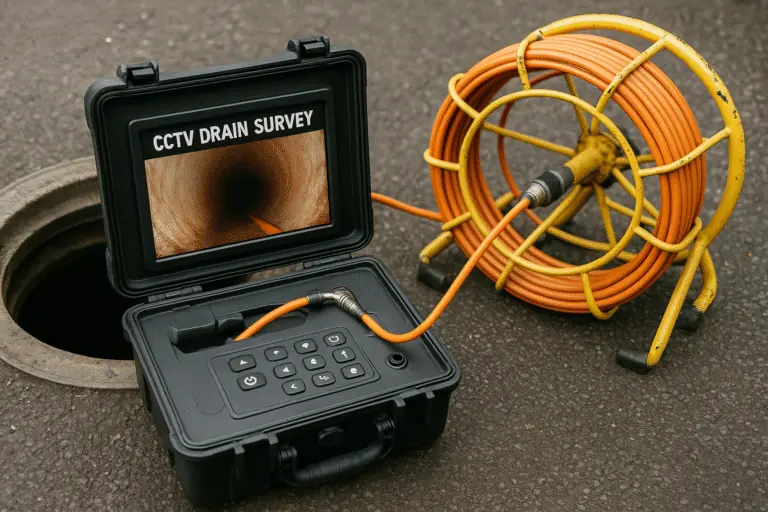
A waterproof camera on a flexible push rod travels along the drain, sending live images to a monitor. The engineer watches for cracks, roots, displaced joints, collapses and build-up.
- 5. Record and note the findings
The engineer records the footage and notes where any defects are along the run, so problems can be located from above ground if repairs are needed.
- 6. Talk you through the results
Before leaving, the engineer explains what the camera found in plain English, what it means for you, and what options there are, from no action to cleaning or repair.
What equipment do we use for drain camera inspections?
Push-rod CCTV drain camera
A compact waterproof camera head on a flexible rod is pushed through domestic drains from a manhole or access point. It is ideal for the narrower pipes found under most London homes and gardens.
Live monitor and recording
Images are shown live on screen as the camera moves, so the engineer can stop, look closely at a defect and record it. You are welcome to watch.
High-pressure water jetting
Where a drain is coated in grease, silt or scale, jetting cleans the pipe walls so the camera gets a clear view. It is often combined with a survey after a stubborn blockage.
Mechanical drain rodding
Rods can clear a blockage that is stopping the camera from getting through, so the rest of the run can be inspected.
Can I check my own drains before booking a survey?
You can do a few simple, safe checks from above ground that help an engineer, but you cannot see inside an underground pipe without a camera.
Safe to try
- Note which sinks, toilets and baths are slow, and whether they get worse after heavy rain.
- Look for sinking paving, damp patches or new cracks near where drains run.
- Wearing gloves, lift a light inspection chamber cover to see whether water is flowing or standing, then replace it securely.
- Find any property plans, seller’s drainage information or previous survey footage you already have.
Avoid
- Never climb into a manhole or inspection chamber; they can contain harmful gases and are not safe to enter.
- Don’t push rods, hoses or pressure washers into a drain you suspect is broken, as this can make a collapse worse.
- Don’t dig down to an underground pipe to look for damage yourself.
- Don’t pour chemical drain cleaners into a drain you think is cracked or collapsed.
- Don’t assume a cleared blockage means the drain is sound if it keeps coming back.
Call a professional straight away if
- Sewage is coming up into your home or overflowing from a manhole.
- A drain keeps blocking soon after being cleared.
- You are exchanging contracts on an older property soon and want to check the drains first.
- Building work, an extension or new foundations are about to start near your drains.
- You notice subsidence, sinking ground or a strong sewage smell near a drain run.
Should I get a homebuyer drain survey before buying a house in London?
Yes, if you are buying an older property, a homebuyer drain survey is one of the most useful extra checks you can do. A standard building survey usually only looks at what is visible above ground, so cracked, root-filled or collapsed pipes under the garden can go unnoticed until after you move in.
Repairs to underground drains can be disruptive, so finding problems before you exchange gives you information while you still have options. You may want to ask the seller about it, renegotiate, or simply plan for the work. This is particularly relevant for Victorian and Edwardian terraces in boroughs such as Lambeth, Wandsworth and Haringey, where many drains are original clay pipes.
A pre-purchase drain survey typically provides a recording of the inside of the pipes and a summary of the findings. Remember that drains serving only your property and within your boundary are usually the owner’s responsibility, while shared sewers and lateral drains beyond the boundary are generally Thames Water’s. Our guide to CCTV drain surveys when buying a house in London explains more.
Do I need a drain survey before an extension or build-over?
Often, yes. A drain survey for an extension shows where your drains run, how deep they are and what condition they are in before any foundations go in, so you can avoid building over a pipe that is already failing.
If you plan to build over or near a public sewer, you may need a build-over agreement with Thames Water. Since October 2011, many shared drains that were once private became public sewers, so a pipe running under a London garden may belong to Thames Water even if it looks like yours. A survey helps you and your builder find this out early.
This comes up a lot with rear and side-return extensions in Southwark and Hammersmith and Fulham, and with basement projects in Camden and Kensington and Chelsea. A second survey once building work is finished can also confirm the drains were not damaged during construction.
How can a camera find a broken drain without digging?
A drain camera finds a broken drain by travelling inside the pipe from an existing access point, so nothing needs to be dug up just to look. The engineer sees the damage on screen and notes how far along the run it is, which helps pinpoint where any repair would be needed.
This matters because guessing can be expensive. Without a survey, you might dig in the wrong place or replace a long run of pipe when only one joint has failed. With clear footage, you can make a decision based on what is actually there. If you suspect damage, read our guide to the signs of a collapsed or broken drain, or our advice on tree roots in drains.
How much does a CCTV drain survey cost in London?
The cost of a CCTV drain survey depends on the property and the job, so we give you a fixed quote before any work starts. There is no call-out fee and no hidden charges.
Things that affect the price include:
- How many drain runs and access points need inspecting.
- How easy it is to reach the manholes or inspection chambers.
- Whether the drain is blocked or fouled and needs rodding or jetting before the camera can see clearly.
- Whether the survey is part of a wider job, such as clearing a recurring blockage.
- The time and day you need us, including evenings and weekends.
Call 0800 470 0946 to tell us what you need, or book online and choose a day and a time window that suits you.
For landlords, agents and businesses
We carry out drain camera inspections for landlords, letting agents, restaurants, offices and shops across London. Landlords and agents use surveys to find the cause of repeat blockages in rented homes and to check drains between tenancies, which helps settle whether a problem comes from damage or from what is going down the drain.
For restaurants, takeaways and cafés, a survey shows how much fat, oil and grease has built up in the pipes and whether jetting is needed. Offices and shops, from the City of London to high streets in Croydon, can book surveys at times that keep disruption to a minimum, as we work 24/7.
Frequently asked questions
What is a CCTV drain survey?
A CCTV drain survey is an inspection where a small waterproof camera is sent through your underground pipes to record what is inside. It shows cracks, tree roots, collapses, displaced joints and blockages without any digging. It is commonly used when buying older homes, before building work, or to find the cause of drain problems that keep coming back.
Do you do CCTV drain surveys in London?
Yes. Pipe & Drain Cleaners carries out CCTV drain surveys across Greater London, covering all 32 boroughs and the City of London. We are available 24 hours a day, 7 days a week, including weekends and bank holidays. You get a fixed quote before work starts and there is no call-out fee. Call 0800 470 0946 or book online.
Is a drain survey worth it when buying a house?
For older properties, usually yes. Standard homebuyer surveys rarely look inside underground pipes, and Victorian or Edwardian drains in London are often clay or pitch-fibre pipes that can crack, collapse or fill with roots. A pre-purchase drain survey gives you information before you exchange, while you can still ask questions or plan for repairs.
How long does a CCTV drain survey take?
It depends on how many drain runs there are, how easy they are to access and whether the pipes need clearing first. A simple domestic drain will take less time than a large property with several runs or a blocked line. We can give you a better idea when you call and tell us about the property.
What does a drain survey report show?
A drain survey typically provides a recording of the inside of the pipes and a written summary of the findings. It shows any defects found, such as cracks, roots, displaced joints or collapses, and roughly where along the run they are. Ask us when booking what you will receive for your particular survey.
Can a CCTV survey find tree roots in my drains?
Yes. Roots are one of the clearest things a drain camera picks up. They enter through cracks and loose joints, then grow inside the pipe, catching paper and grease. London plane trees and garden trees are common culprits. The survey shows where the roots are and how much of the pipe they block.
Do I need a drain survey for a build-over agreement?
It often helps. If you are building over or near a public sewer, you may need a build-over agreement with Thames Water, and knowing where the pipe runs and its condition is useful early in planning. Check Thames Water's current requirements for your project, and speak to your builder or architect about what they need.
Will a drain survey help with an insurance claim?
It can. Footage showing the condition of a pipe and where the damage is can support a claim for a broken or collapsed drain. Insurers have their own processes, so contact them first to check what evidence they need and whether they want to arrange the survey themselves.
Do you need to dig to do a drain camera inspection?
No. The camera goes in through existing access points such as manholes, inspection chambers, rodding points or gullies. If a drain is blocked, the engineer may need to clear it first by rodding or jetting so the camera can see. Digging only comes into it later, if a repair is needed.
Helpful guides
CCTV Drain Survey London: every borough
We work across all 32 London boroughs and the City of London, day and night. Choose your area or find your postcode.
- Barking and Dagenham
- Barnet
- Bexley
- Brent
- Bromley
- Camden
- City of London
- Croydon
- Ealing
- Enfield
- Greenwich
- Hackney
- Hammersmith and Fulham
- Haringey
- Harrow
- Havering
- Hillingdon
- Hounslow
- Islington
- Kensington and Chelsea
- Kingston upon Thames
- Lambeth
- Lewisham
- Merton
- Newham
- Redbridge
- Richmond upon Thames
- Southwark
- Sutton
- Tower Hamlets
- Waltham Forest
- Wandsworth
- Westminster
Blocked right now? We're open 24/7
Call free on 0800 470 0946 any time, or pick a time that suits you online.