
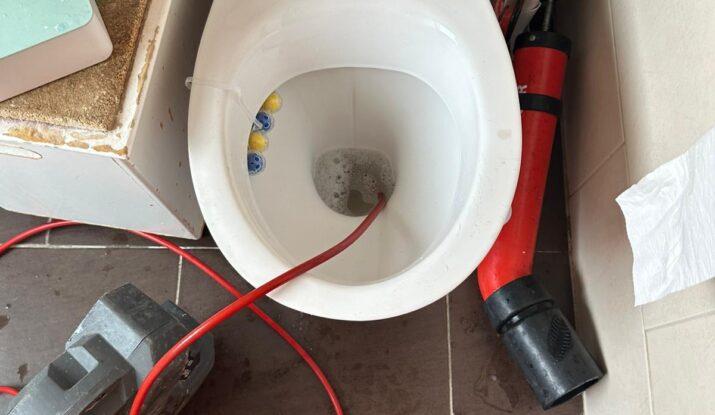
Quick answer
To unblock a toilet, stop flushing, put on gloves and use a flange plunger with firm push-and-pull strokes. If that fails, try washing-up liquid with hot (never boiling) water, then a toilet auger. If the bath, shower or sinks also back up, the blockage is in the drain and needs professional clearing.
Key takeaways
- Stop flushing as soon as the water rises: extra flushes cause overflows.
- A flange plunger is the right tool; a flat sink plunger will not seal.
- Use hot, not boiling, water: boiling water can crack the porcelain.
- Never mix chemical drain cleaners or plunge after using one.
- If several fittings back up at once, the problem is the drain, not the toilet.
What is the quickest safe way to unblock a toilet?
The quickest safe way to unblock a toilet is usually a flange plunger used with firm, steady strokes. Most toilet blockages are caused by too much toilet paper or something that should not have been flushed, and a good plunger shifts many of them.
Before you start, stop flushing. Every extra flush adds water to a bowl that cannot drain and makes an overflow more likely.
What you need
- Rubber gloves, ideally long ones, because toilet water carries bacteria.
- A flange plunger: the type with an extra rubber sleeve under the cup that fits into the toilet outlet. A flat sink plunger will not seal properly.
- Old towels or newspaper around the base of the toilet.
- A bucket, in case you need to scoop out some water first.
How do you plunge a toilet properly?
Plunge a toilet by sealing the cup over the outlet, then pushing and pulling sharply without breaking the seal. The pull stroke matters as much as the push, because the change in pressure is what loosens the blockage.
- Check there is enough water in the bowl to cover the plunger cup. If the bowl is close to the rim, scoop some into the bucket.
- Lower the plunger in at an angle so it fills with water rather than air, then fit the flange into the outlet.
- Press down gently first to push out the air, then plunge firmly up and down 10 to 15 times while keeping the seal.
- Lift the plunger away. If the water drains with a gurgle, the blockage has probably moved.
- Test with a single flush and watch the water level. If it rises towards the rim, stop and plunge again.
It often takes several rounds. If nothing has changed after three or four attempts, move on to the next method.
Does hot water and washing-up liquid unblock a toilet?
Hot water and washing-up liquid can clear a soft blockage, such as a build-up of toilet paper, as long as the water is hot rather than boiling. Boiling water can crack a porcelain pan and damage the seals behind the toilet.
- Squeeze a generous amount of washing-up liquid into the bowl.
- Leave it for around 10 to 15 minutes so it can coat the blockage.
- Pour in a bucket of hot tap water (or a kettle that has been left to cool for a while) from about waist height.
- Leave it again, then try the plunger.
This method does nothing for solid objects such as a toy, a nappy or a sanitary product. Those need removing, not softening.
How do you use a toilet auger?
A toilet auger, sometimes called a closet auger, is a short cranked cable designed to reach through the toilet’s internal bend, and it is the next step when a plunger fails. Choose one with a rubber or plastic guard on the bend so it does not scratch the glaze.
- Pull the cable back into the handle so only the tip shows.
- Place the curved end in the bowl with the guard resting against the outlet.
- Turn the handle clockwise while gently pushing down to feed the cable through the trap.
- When you feel resistance, keep turning to break up or hook the blockage. Do not force it.
- Wind the cable back slowly, flush once to test, and clean the auger in a bucket of hot soapy water.
Avoid straightened coat hangers and other improvised tools. They scratch the pan and can push a blockage further into the pipework, where it is harder to reach.
What should you never do when a toilet is blocked?
Never keep flushing, never pour boiling water into the bowl and never mix chemical drain cleaners. These are the mistakes most likely to turn a simple blockage into a flood, a cracked pan or a safety risk.
- Do not mix chemicals. Combining different drain cleaners, or a drain cleaner with bleach, can produce heat and harmful fumes.
- Do not plunge after using a chemical cleaner. Plunging can splash caustic water onto your skin and into your eyes. If you have already used one, tell anyone who comes to help.
- Do not use boiling water. The sudden heat can crack the pan.
- Do not push objects deeper. If you can see wipes or a toy, wear gloves and lift them out rather than plunging them further in.
- Do not work in a closed room. Open a window, especially if there is a sewage smell.
Many chemical drain products are not made for toilets, and they rarely shift wipes, sanitary products or objects. Read the label carefully, and if in doubt, leave them out.
How do you know it is a drain problem, not the toilet?
If more than one fitting is affected, the problem is almost certainly in the drain rather than the toilet. A blockage inside the toilet only affects that toilet; a blockage further down affects everything that drains into the same pipe.
Signs that point to a blocked drain:
- The bath, shower or a downstairs sink drains slowly or backs up when you flush.
- Other plugholes gurgle when the toilet is flushed.
- Several toilets in the house are slow at the same time.
- The manhole or inspection chamber outside is full of water or waste.
- There is a sewage smell outside as well as inside.
Plunging will not fix a drain blockage, and repeated flushing can push sewage back up through the lowest fitting in the property, often a ground-floor toilet or shower. At that point the drain needs clearing with rods or high-pressure water jetting. Our blocked drains page explains what that involves.
In flats and terraced houses the blockage may be in a shared section of drain. Since 1 October 2011, shared private sewers and lateral drains have generally been the responsibility of the water company, which across London is Thames Water. A drainage engineer can show you where the blockage is and who is likely to be responsible.
What causes toilets to block in the first place?
Most toilet blockages are caused by things that should never have been flushed. The simple rule is that only pee, poo and toilet paper should go down the toilet.
- Wet wipes, including many labelled “flushable”, which often do not break down like toilet paper.
- Sanitary products and nappies.
- Cotton buds, cotton wool and dental floss.
- Large amounts of toilet paper in one go. Flushing part-way through helps.
- Children’s toys and other small objects.
Older properties, such as the Victorian terraces found in boroughs like Islington and Lambeth, can also have underlying drain faults, such as cracked clay pipes or tree root ingress, that catch waste and cause repeat blockages. If your toilet blocks again and again, a CCTV drain survey can show what is happening inside the pipe.
When should you call a professional?
Call a professional if plunging and an auger have not worked, if more than one fitting is affected, or if sewage is coming back up. It is also worth getting help if a solid object is stuck out of reach, because taking a toilet pan off without the right tools can damage the pan and its connector.
If it is the only toilet in the home, most people treat it as urgent. Our blocked toilet page explains how our engineers clear toilets and the drains behind them.
Need help with a blocked toilet?
If the toilet still will not clear, Pipe & Drain Cleaners can help across London, day or night. Call 0800 470 0946 24/7, or book a morning, afternoon or late-afternoon slot online. You will get a fixed quote before any work starts.
Frequently asked questions
Can I use bleach to unblock a toilet?
Bleach is not a good way to unblock a toilet. It cleans and disinfects but does little to break down paper, wipes or objects. More importantly, mixing bleach with drain cleaners or other bathroom products can release harmful fumes. Stick to a plunger, washing-up liquid with hot water, or a toilet auger.
Why does my toilet keep blocking?
A toilet that blocks repeatedly usually has a problem further down the pipe. Common causes are a build-up of wipes or sanitary products, a partial blockage in the drain, a low-flush toilet struggling with paper, or a damaged drain such as a cracked or root-invaded pipe. A CCTV drain survey can find the cause so it can be fixed properly.
Will a blocked toilet clear itself?
A toilet blocked by toilet paper sometimes clears on its own as the paper softens over a few hours. Wipes, sanitary products and objects will not. If the water level slowly drops, try plunging. If it stays high, or other fittings are affected, it is unlikely to clear without help.
Is it safe to use a blocked toilet that is draining slowly?
It is best to avoid using it until it is cleared. A slow-draining toilet can overflow without warning, especially if the blockage is in the drain and other appliances are emptying into the same pipe. Use another toilet if you have one, and keep children and pets away from any dirty water.
Should I lift the manhole cover to check the drain?
You can look, but take care. Covers can be heavy and edges sharp, so wear gloves and lift with your legs. If the chamber is full of water or sewage, the blockage is further down the drain. Do not climb in or put your head inside, and replace the cover securely afterwards.
Need a drain engineer in London?
Call free on 0800 470 0946 any time, or pick a time that suits you online.