
Engineers available 24/7 across London
Blocked Toilet Unblocking in London
Toilet won't flush, rising or overflowing? Our engineers clear pans, traps and soil pipes across London, day and night.
Call free, any time0800 470 0946
- 24/7, including bank holidays
- No call-out fee
- Fixed quote before work starts
- 20+ vans across London
Speak to an engineer now
Freephone · answered 24 hours a day
- No call-out fee
- Fixed quote before work starts
- Trained, insured engineers
- All 32 boroughs + the City
Quick answer
Pipe & Drain Cleaners unblock toilets across all 32 London boroughs and the City, 24 hours a day, 7 days a week. Our trained, insured engineers clear blockages in the pan, trap, soil pipe or underground drain using rodding, jetting and CCTV. You get a fixed quote before work starts and no call-out fee. Call 0800 470 0946 or book online.
A blocked toilet in London is one of the most stressful drainage problems you can have, especially when it is the only toilet in the flat or the water is rising towards the rim. Pipe & Drain Cleaners is a London drainage company that clears blocked toilets around the clock, from a single slow-flushing pan in a Islington conversion to every toilet backing up in a Lambeth terrace.
Most toilet blockages sit in one of three places: the pan and its U-bend, the soil pipe or soil stack that carries waste down the building, or the underground drain beyond it. Our engineers have 12+ years’ experience and carry the equipment to deal with all three, including drain rods, high-pressure jetting and CCTV cameras.
We cover homes, landlords, letting agents and businesses in every borough, from Barnet and Haringey in the north to Croydon in the south. You always get a fixed quote before we start, with no call-out fee and no hidden charges. If the toilet is overflowing now, call 0800 470 0946.
How do I know if my toilet is blocked?
The water rises when you flush
If the bowl fills towards the rim and drains slowly, something is restricting the pan, trap or pipe. Stop flushing.
The toilet won't flush properly
Waste swirls but does not leave the bowl, or needs several flushes. A weak flush with a full cistern usually points to a partial blockage rather than a cistern fault.
Gurgling or bubbling
Air bubbling back up through the bowl, or gurgling when the bath or sink drains, suggests the soil pipe or drain below is partly blocked.
Bad smells from the toilet
A sewage smell that lingers after cleaning can come from waste trapped in the pipework. Our guide on why drains smell covers other causes.
More than one toilet or fitting is affected
If an upstairs and downstairs toilet both back up, or the shower drains slowly too, the blockage is almost certainly in the shared drain, not the toilet.
Water at an outside gully or manhole
Dirty water or toilet paper appearing at a gully or inspection chamber cover means the underground drain is blocked and the toilet is just the first place it shows.
What causes blocked toilets in London homes?
Wet wipes and "flushable" wipes
Wipes are the most common cause we see. Many wipes labelled “flushable” do not break down like toilet paper, so they snag in the trap or drain and build into a solid mass. Only pee, poo and toilet paper are fine to flush.
Sanitary products, nappies and cotton buds
Tampons, pads, nappies, cotton buds, dental floss and kitchen roll do not dissolve. They catch on joints and build up until the toilet blocks.
Objects dropped in the pan
Toys, toothbrushes, phones, air fresheners and toilet rim blocks often lodge in the U-bend. These need careful removal rather than forcing them further down.
Limescale in the trap
Toys, toothbrushes and toilet rim blocks often lodge in the U-bend and need careful removal rather than forcing further down.
Old or damaged soil pipes and drains
Many Victorian and Edwardian London homes still have clay or pitch-fibre drains. Cracks, displaced joints, sagging sections and tree roots can catch waste and cause toilets to block again and again.
Fat and grease further down the drain
Where kitchen and toilet waste share a drain, fat, oil and grease (FOG) can coat the pipe and trap wipes, forming a mini fatberg that backs up the toilet.
Need it sorted today?
Call free on 0800 470 0946 any time, or pick a time that suits you online.
How we unblock a toilet: step by step
- 1. You call or book
Phone us at any hour for an emergency, or book online and choose a morning, afternoon or late-afternoon slot. Tell us how many toilets are affected and whether water is overflowing.
- 2. We find where the blockage is
The engineer checks the pan, the other fittings and any accessible inspection chambers to work out whether the problem is in the toilet, the soil stack or the underground drain.
- 3. Fixed quote before work starts
Once we know what we are dealing with, you get a clear, fixed quote. There is no call-out fee and nothing is added later without your agreement.
- 4. We clear the blockage
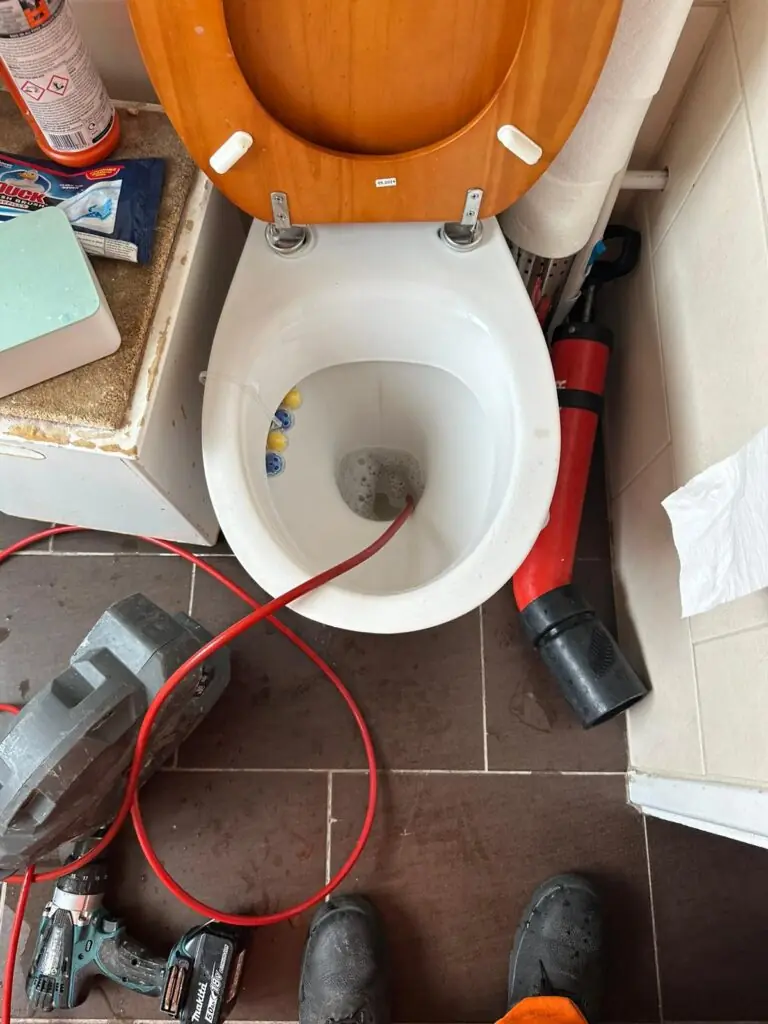
Depending on its location, we use a toilet auger, drain rods or high-pressure water jetting to remove the blockage completely rather than just pushing it along.
- 5. Test and clean up
We flush repeatedly and run other fittings to confirm everything drains freely, then leave the area clean and tidy.
- 6. Advice to stop it coming back
If we suspect a damaged pipe, we explain what we found and whether a CCTV drain survey would help.
What equipment do you use to unblock toilets?
Toilet auger and hand tools
For blockages in the pan or trap, a toilet auger reaches round the U-bend without scratching the porcelain.
Mechanical drain rodding
For blockages in the soil pipe or the drain, we use drain rods from the nearest inspection chamber or access point to break through and pull out wipes and debris.
High-pressure water jetting
Jetting scours the inside of the drain, flushing away wipes, scale and grease along the full length of the pipe. Find out more about drain jetting and sewer cleaning.
CCTV drain camera
If a toilet keeps blocking, a camera inspection shows cracks, roots, collapses or displaced joints in the soil pipe and drain. See our CCTV drain surveys.
Can I unblock a toilet myself?
Yes, if only one toilet is affected and nothing else in the house is slow, a simple blockage in the pan can often be cleared safely. Our step-by-step guide on how to unblock a toilet covers this in more detail.
Safe to try
- Stop flushing and, if the water is rising, turn off the isolation valve on the pipe to the cistern or lift the cistern lid and hold up the float.
- Use a flange plunger (the type with a soft extension at the bottom) and plunge firmly 10 to 15 times with the cup covered by water.
- Try a squeeze of washing-up liquid followed by a bucket of hand-hot (not boiling) water poured from waist height, then wait 15 minutes.
- Check whether other sinks, baths and toilets drain normally before trying anything else.
Avoid
- Don’t keep flushing to “push it through”, as this is how toilets overflow.
- Don’t pour boiling water into the pan; it can crack the porcelain.
- Don’t use caustic soda or mix drain chemicals. They can splash, give off fumes and damage seals, and are dangerous for the engineer who comes next.
- Don’t force a coat hanger or wire into the trap; it scratches the glaze and can wedge objects tighter.
- Don’t lift manhole covers or put your hands into inspection chambers; leave the underground drain to a professional.
Call a professional straight away if
- The toilet is overflowing or sewage is coming back up into the bowl, bath or shower.
- More than one toilet, or the toilet plus other fittings, are blocked or gurgling.
- Plunging hasn’t worked after a few attempts, or something solid has been dropped in the pan.
- Water or toilet paper is showing at an outside gully or manhole.
- It is the only toilet in the property, or the property has vulnerable occupants.
Why are all the toilets in my house blocked at once?
When every toilet in the house is blocked, the problem is almost never in the toilets themselves. It is in the soil stack or, more often, the underground drain that all the toilets share. A blockage there backs waste up into the lowest fitting first, which is usually a ground-floor toilet, shower or the downstairs bath.
Signs that you are dealing with a drain blockage rather than a toilet blockage include:
- An upstairs flush makes the downstairs toilet bubble or rise.
- Baths, showers and sinks drain slowly at the same time.
- The nearest inspection chamber outside is full of water.
Plungers will not fix this. Stop using water and call us. We clear the drain from the inspection chamber with rods or drain unblocking equipment, then test every toilet.
This is common in large Victorian houses converted into flats in areas like Hackney, Camden and Wandsworth, where several households share one old clay drain. Shared drains and those outside your boundary are usually Thames Water’s responsibility; our guide on who is responsible for a blocked drain explains the rules.
What is a blocked soil pipe, and how is it fixed?
A blocked soil pipe is a blockage in the large vertical pipe, also called a soil stack, that carries waste from your toilets down to the underground drain.
Soil pipe blockages usually happen at the bends: where the toilet connects to the stack, or at the foot of the stack where it turns into the drain. Wipes, sanitary products and scale collect at these points. Typical signs are a toilet upstairs that drains slowly, gurgling in other fittings and a sewage smell near the pipe.
We clear soil pipes by rodding or jetting from an access point or the inspection chamber below, never by cutting into pipework unless it is genuinely damaged. If a stack keeps blocking, a CCTV inspection can show whether a joint has slipped or the bend has cracked. In blocks of flats, a shared stack is normally the responsibility of the freeholder or managing agent, so check with them before booking.
What should I do if my macerator or Saniflo toilet is blocked?
Switch off the power to the unit first, then stop using the toilet and any basin or shower connected to it. Macerator toilets, often fitted in basement flats, loft bathrooms and extensions where there is no gravity drain, pump waste through a narrow pipe, so they block more easily than a standard toilet.
General points to bear in mind:
- Don’t use a plunger or drain chemicals on a macerator; check the manufacturer’s instructions for what is safe.
- Constant running, humming or the unit cutting out often points to a blockage or a fault in the pump itself.
If the blockage is in the discharge pipe or the drain it pumps into, that is drainage work we can help with. A fault in the motor or electrics needs the manufacturer’s service engineer or a qualified plumber. Tell us on the phone that it is a macerator so we can advise you before the visit.
How much does it cost to fix a blocked toilet in London?
The cost of unblocking a toilet depends on where the blockage is and how it has to be cleared, so we give you a fixed quote once the engineer has assessed it, before any work starts. There is no call-out fee and no hidden charges.
The main things that affect the price are:
- Where the blockage is: in the pan, in the soil stack, or in the underground drain.
- Access: whether there is an easy inspection chamber, a boxed-in stack, or a basement or upper-floor flat.
- Method: hand tools and an auger, drain rods, or high-pressure jetting.
- Whether CCTV is needed to find a recurring cause such as a cracked or displaced pipe.
Call 0800 470 0946 for a quote, or book online and choose a time window that suits you.
For landlords, agents and businesses
Landlords and letting agents call us when a tenant reports a blocked or overflowing toilet, often out of hours. We attend, clear the blockage and explain what caused it, which helps when deciding who pays. Landlords are usually responsible for the drains in a rented home, while tenants are usually responsible for blockages they cause, such as flushing wipes or sanitary products, so check the tenancy agreement. Our guide on landlord or tenant: who pays for blocked drains covers this.
We also unblock toilets for offices, shops, restaurants, pubs and other businesses across London, from busy washrooms in Westminster and the City of London to high-street premises in outer boroughs. Customer toilets often block with wipes and paper towels, and restaurant drains also carry fat and grease.
Frequently asked questions
Who can unblock a blocked toilet in London tonight?
Pipe & Drain Cleaners unblock toilets across London 24 hours a day, 7 days a week, including weekends and bank holidays. Call us and we will send an engineer as quickly as possible and give you an ETA on the phone. There is no call-out fee, and you get a fixed quote before any work starts.
Is there toilet unblocking near me in every part of London?
Yes. We cover all 32 London boroughs and the City of London, with 20+ vans spread across the capital, from Enfield and Havering to Kingston and Hillingdon. We only work within Greater London. Book a three-hour slot online for routine jobs, or phone any time for an emergency.
Is a blocked toilet an emergency?
A blocked toilet is an emergency if it is overflowing, sewage is coming back up, or it is the only toilet in the home. A slow-flushing toilet with other fittings working normally is usually less urgent and can often be booked for a convenient slot. Our guide on whether a blocked drain is an emergency explains how to decide.
Why won't my toilet flush even though the cistern is full?
If the cistern fills but the toilet won't flush away, the outlet is most likely partly blocked in the trap, soil pipe or drain. If the cistern is not filling or the handle feels loose, the fault is in the flush mechanism instead, which is a plumbing repair. Check whether other fittings are slow to tell a blockage from a cistern fault.
What should I do if my toilet is overflowing?
Stop flushing straight away, then turn off the isolation valve on the cistern's water supply or lift the cistern lid and hold up the float. Put towels down, keep children and pets away, and avoid using other sinks or baths. If water keeps rising or sewage is coming up, call a drainage engineer immediately.
Are flushable wipes really fine to flush?
No. Many wipes labelled "flushable" do not break down quickly like toilet paper, so they catch in traps, soil pipes and drains. In London's sewers they combine with fat and grease to form fatbergs, like the huge one found in Whitechapel in 2017. Only pee, poo and toilet paper should go down the toilet.
Do landlords or tenants pay to unblock a toilet?
Landlords are usually responsible for keeping drains and toilets in working order in a rented home. Tenants are usually responsible if they caused the blockage, for example by flushing wipes, nappies or sanitary products. Check the tenancy agreement, and ask the engineer to explain what caused the blockage, as this often settles the question.
Why does my toilet keep blocking again and again?
A toilet that blocks repeatedly usually has a problem further down: scale in the trap, a damaged or sagging soil pipe, roots in an old clay drain, or a build-up of wipes and grease. Clearing it fixes the symptom, and a CCTV drain survey can find the cause so it can be repaired properly.
Helpful guides
Blocked Toilet Unblocking in London: every borough
We work across all 32 London boroughs and the City of London, day and night. Choose your area or find your postcode.
- Barking and Dagenham
- Barnet
- Bexley
- Brent
- Bromley
- Camden
- City of London
- Croydon
- Ealing
- Enfield
- Greenwich
- Hackney
- Hammersmith and Fulham
- Haringey
- Harrow
- Havering
- Hillingdon
- Hounslow
- Islington
- Kensington and Chelsea
- Kingston upon Thames
- Lambeth
- Lewisham
- Merton
- Newham
- Redbridge
- Richmond upon Thames
- Southwark
- Sutton
- Tower Hamlets
- Waltham Forest
- Wandsworth
- Westminster
Blocked right now? We're open 24/7
Call free on 0800 470 0946 any time, or pick a time that suits you online.