Quick answer
Stop running water into the blocked fitting, put on gloves and work out whether one fitting or several are affected. For a single sink, bath or toilet, try a plunger, then hand-hot water and washing-up liquid, then clean the trap. Never mix chemical drain cleaners. If several fittings back up or sewage appears, call a professional.
Key takeaways
- Stop using water in the affected fitting so it doesn't overflow.
- One slow fitting is usually a local blockage you can often clear yourself.
- Several fittings backing up points to a blocked underground drain.
- Never mix chemical drain cleaners or use them after plunging.
- Sewage coming up into your home needs a professional, not DIY.
What should I do first when a drain is blocked?
Stop running water into the blocked sink, bath, shower or toilet straight away. Every extra litre raises the risk of an overflow, and if the blockage is in the underground drain, water from other fittings can come back up at the lowest point in the house.
Then take a moment to get ready:
- Put on rubber gloves, and ideally eye protection if you may use a plunger on a sink.
- Lay old towels around the fitting.
- Keep children and pets away from the area.
- Open a window if there is a smell.
How do I know where the blockage is?
Check whether one fitting is affected or several. This single check tells you most of what you need to know.
- Only one sink, bath or toilet is slow: the blockage is probably in that fitting, its trap or its short waste pipe. This is often something you can clear yourself.
- Several fittings are slow, or a toilet gurgles when you run the bath: the blockage is likely further down, in the shared waste pipe or the underground drain.
- Water is coming up from an outside gully or a manhole cover: the underground drain is blocked.
If it looks like an underground drain problem, skip to the section on when to call a professional. DIY rarely fixes those, and pushing more water down makes things worse.
What are the safe DIY steps, in order?
For a blocked sink, bath, shower or toilet, work through these steps from the gentlest to the most hands-on. Stop as soon as the water drains freely.
1. Remove what you can see
With gloves on, lift out the plug or strainer and clear any hair, food or soap build-up you can reach. In showers and baths, hair caught just below the plughole is one of the most common causes.
2. Use a plunger
A plunger is the most effective household tool for a local blockage. Use a cup plunger for sinks and baths and a flange plunger for toilets.
- Block the overflow hole with a damp cloth so the pressure goes down the pipe.
- Make sure there is enough water to cover the plunger cup.
- Push down gently first to push the air out, then plunge firmly up and down 10 to 15 times.
- Lift off and see if the water drains. Repeat a few times if needed.
3. Try hand-hot water and washing-up liquid
For greasy kitchen sinks, a good squeeze of washing-up liquid followed by a kettle of hot water (not boiling) can loosen fat. Avoid boiling water in toilets, as it can crack porcelain, and on plastic waste pipes, where it can soften joints.
4. Clean the trap
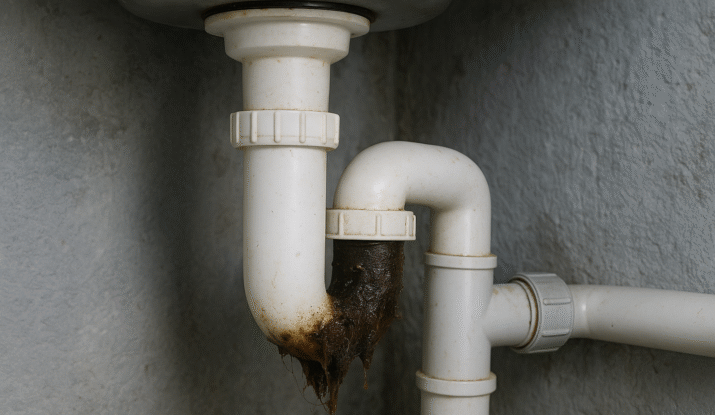
Most sinks have a U-bend or bottle trap under the basin that unscrews by hand. Put a bucket underneath, unscrew it slowly, empty it and rinse it out, then refit it firmly and run water to check for leaks.
5. Clear an outside gully
If a gully outside your back door is overflowing, the blockage may be in the grated trap itself. With thick gloves, lift the grate and scoop out leaves, food and fat into a bag. If water still won’t go down, the problem is deeper in the drain.
What should I never do with a blocked drain?
Some common fixes make blockages worse or are genuinely dangerous. Avoid the following:
- Never mix chemical drain cleaners. Different products can react together and release harmful fumes or heat. Never pour one product on top of another.
- Don’t use chemicals after plunging, or plunge after using chemicals. Plunging can splash caustic liquid onto your skin and eyes.
- Don’t keep flushing a blocked toilet. One flush to test is enough; more risks an overflow.
- Don’t push wire coat hangers deep into pipes. They can scratch fittings and pack the blockage tighter.
- Never climb into a manhole or inspection chamber. They can contain harmful gases and are not safe to enter.
- Don’t pour fat, oil or grease down the sink to “flush it through”. It sets in the pipes and builds up over time.
If you have already used a chemical cleaner and it hasn’t worked, tell whoever comes to clear the drain so they can take precautions.
When should I stop and call a professional?
Stop DIY and get professional help if any of the following apply:
- Two or more fittings are blocked or slow at the same time.
- Sewage or dirty water is coming up into a shower, bath, toilet or floor drain.
- An outside manhole or gully is overflowing.
- You’ve tried plunging and cleaning the trap and nothing has changed.
- There is a persistent sewage smell inside or outside.
- The same drain keeps blocking every few weeks.
These usually point to a blockage in the underground drain, or to a damaged pipe. A drainage engineer can clear it with mechanical rodding or high-pressure water jetting, and if it keeps coming back, a CCTV drain survey can show why.
If sewage is backing up into your home, avoid touching it, keep everyone away from the area and call a professional promptly. Basement and lower-ground-floor flats, common across London, tend to be the first place backed-up water appears.
Is the blockage my responsibility?
Blockages in your own fittings and in drains that serve only your property within your boundary are usually your responsibility, or your landlord’s if you rent. Shared drains and pipes beyond your boundary are generally Thames Water’s. If you’re unsure, lifting an inspection chamber cover (with gloves, and never climbing in) can show whether the blockage is in your section of pipe.
How can I stop it happening again?
Most household blockages come from what goes down the drain. A few habits make a real difference:
- Only flush pee, poo and toilet paper. Wipes labelled “flushable” often don’t break down.
- Let fat, oil and grease cool, then scrape it into the bin rather than the sink.
- Use sink strainers and a plughole hair catcher.
- Keep outside gullies clear of leaves, especially in autumn.
Need help with a blocked drain?
If DIY hasn’t worked, Pipe & Drain Cleaners can help with blocked drains, toilets and sinks across London, from Hackney to Wandsworth. You’ll get a fixed quote before any work starts. Call 0800 470 0946 24/7, or book online.
Frequently asked questions
Does bicarbonate of soda and vinegar unblock drains?
It can help with minor build-up in a sink or bath, but it rarely clears a proper blockage. The fizzing reaction is mild and mostly loosens soap scum and light grime near the plughole. It is no substitute for a plunger or for cleaning the trap, and it won't clear a blocked underground drain. Don't combine it with chemical drain cleaners.
Are chemical drain cleaners safe to use?
They can be used with care for minor sink blockages, but they carry real risks. Follow the label exactly, wear gloves and eye protection, ventilate the room, and never mix products or use one straight after another. They often fail on solid blockages such as wipes, and repeated use can damage older pipes and fittings.
Why is water coming up in my shower when I flush the toilet?
This usually means the shared waste pipe or underground drain is blocked further down. Water from the toilet can't get past the blockage, so it rises at the lowest outlet, often a shower tray or bath. Stop using water in the house and call a drainage engineer, as plunging the shower won't fix it.
Can I use a pressure washer to unblock an outside drain?
It isn't recommended. Domestic pressure washers aren't designed for drains, can push debris further in and pack it tighter, and can spray contaminated water back at you. Professional drain jetting uses dedicated hoses and nozzles that travel inside the pipe, along with the right protective equipment, which is a very different job.
How do I know if my drain blockage is an emergency?
Treat it as urgent if sewage is coming into your home, a toilet is overflowing and you have no other working toilet, or wastewater is flooding a garden, basement or neighbouring property. In those cases stop using water, avoid contact with the sewage and call a professional straight away rather than waiting.
Need a drain engineer in London?
Call free on 0800 470 0946 any time, or pick a time that suits you online.